«لِخَوْلةَ أَطلالٌ ببُرْقَةِ ثَهْمَدِ»: “Khawla has ruins of a camp at Burqat Thahmad.” It is a half-line many Arabic speakers remember from their school days, along with the name of the man who composed it: Tarafa ibn al-Abd. What fewer remember is that the classical Arabic sources place the end of this poet’s road at Hajar, and Hajar, for Yaqut al-Hamawi, is the chief town of the region in which Al-Ahsa lies.
This article gives three answers from those sources themselves: whether Tarafa ibn al-Abd was from Al-Ahsa, what Hajar and al-Bahrayn mean in the reports about him, and what remains for a visitor today. We pass on what these books relate in their own words, and we say where they fall silent.
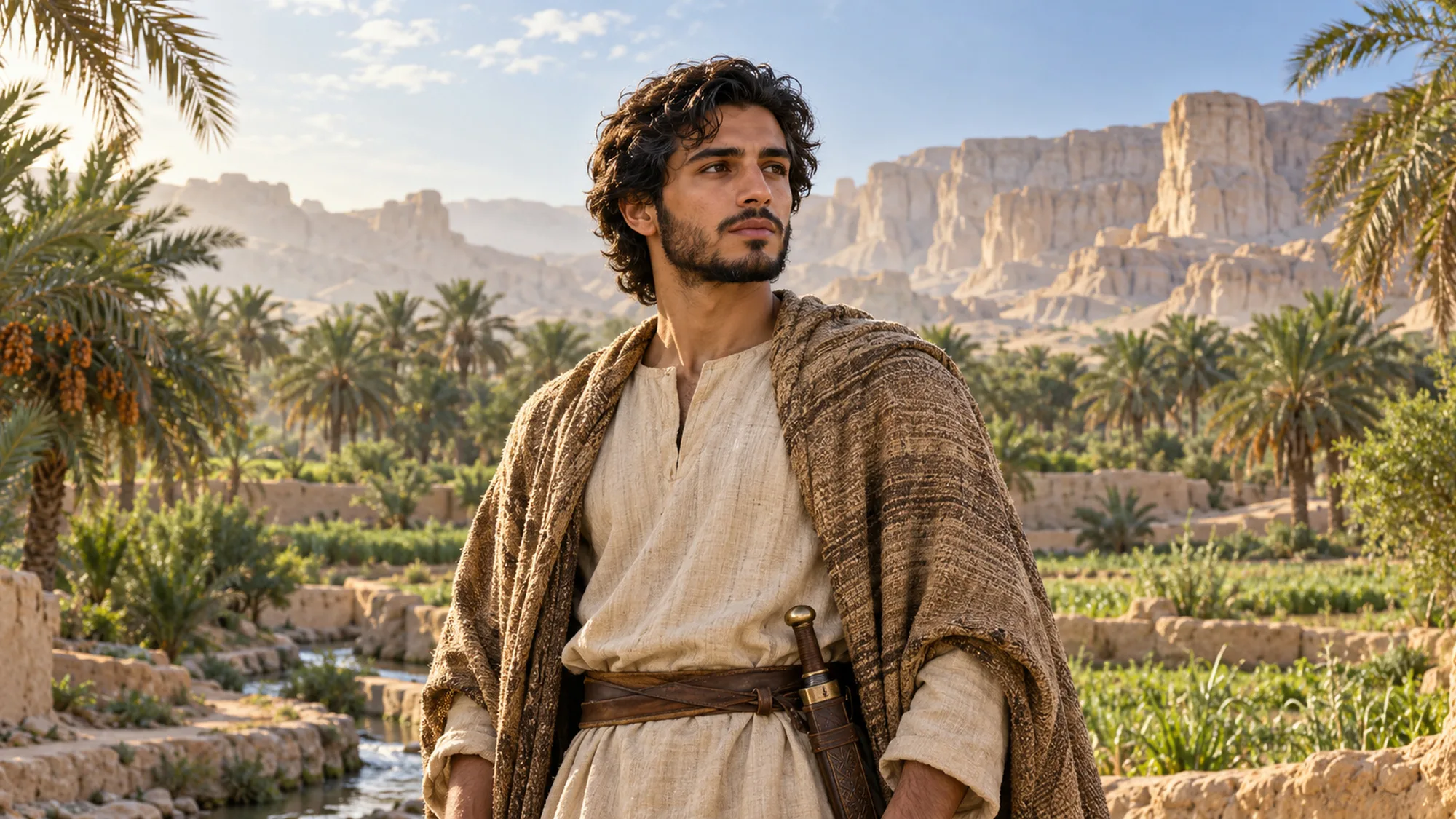
The image at the top of this article is an imagined, AI-generated depiction, not a portrait of the poet.
Who Was Tarafa ibn al-Abd?
Tarafa ibn al-Abd was a Jahili poet, that is, one of the poets from before Islam, of the tribe of Bakr ibn Wa’il, and his Mu’allaqa is the long ode on the strength of which the early critics ranked him. His lineage in Ibn Sallam al-Jumahi (d. 232 AH) runs: Tarafa ibn al-Abd ibn Sufyan ibn Sa’d ibn Malik ibn Dubay’a ibn Qays ibn Tha’laba, and al-Baghdadi (d. 1093 AH) carries it up to Bakr ibn Wa’il. Ibn Qutaybah (d. 276 AH) notes that his name is said to have been Amr, that he was called Tarafa after a verse he composed, and that his mother was Warda.
He grew up an orphan. Ibn Qutaybah says: “Tarafa’s father had died while Tarafa was small, and his paternal uncles refused to divide his property.” His Mu’allaqa has a verse on the injustice of kin:
وظُلمُ ذَوِي القُرْبى أَشَدُّ مَضَاضة عَلَى المرءِ من وقع الحُسام المُهَنّدِ
The injustice of close kin stings a man more sharply than the stroke of a keen Indian sword.
The attribution of this verse has long been disputed: Ibn al-Anbari (d. 328 AH) gives the verse in his commentary on the Mu’allaqa, then quotes Abu Ja’far as saying that the verse is not from Tarafa’s ode but belongs to Adi ibn Zayd al-Ibadi.
His standing is high, though little of his poetry survived. Ibn Sallam put him in the fourth class of the master poets, four men who in his words “belong with the foremost, and were held back only by how little of their poetry is in the hands of the transmitters”, and said of him: “As for Tarafa, he is the best poet of all for a single poem”, meaning his Mu’allaqa. Ibn Qutaybah said: “He is the finest of them in a long ode.” And Ibn Qutaybah relates from Abu Ubayda that Labid was asked who the best poet of the Arabs was; he named Imru’ al-Qays, then said: “The 20-year-old”, meaning Tarafa.
Was Tarafa ibn al-Abd from Al-Ahsa? What the Classical Sources Say and Where They Are Silent
In the accounts of Tarafa ibn al-Abd given by Ibn Sallam, Ibn Qutaybah, Ibn al-Anbari and al-Baghdadi we found no text that names his birthplace. What these books relate is a different link to Hajar, one better anchored in the texts: it lies in his end, not in his birth.
Three passages carry that link:
- Where the letter was addressed: in Ibn al-Anbari’s account, Amr ibn Hind wrote for Tarafa and al-Mutalammis “to his governor over al-Bahrayn and Hajar”, the governor being the man he had set over them. Al-Mutalammis was Tarafa’s maternal uncle, as al-Baghdadi notes. Al-Bahrayn here is a wide ancient region whose chief town is Hajar; it is explained in the section on the old names below.
- Where they met: “Then Tarafa travelled on until he came to the governor of al-Bahrayn, who was at Hajar.”
- The grave: “His grave today is at Hajar, on a piece of its land belonging to Banu Qays ibn Tha’laba.” Banu Qays ibn Tha’laba are his own people, as his lineage shows. “Today” here is the narrator’s day, not ours.
Yaqut al-Hamawi (d. 626 AH) records that before its conquest al-Bahrayn held “a great many people of Abd al-Qays, Bakr ibn Wa’il and Tamim, living in its open country”. That describes the region before its conquest; it is not a text about the poet’s own time.
The explicit statement about his birth is a modern one: Saudipedia says he was born “in Al-Ahsa Governorate, which used to be known as ‘Hajar’”. We report it as Saudipedia’s statement, and set beside it the silence of the early sources.
How Did Tarafa ibn al-Abd Die? The Story of the Letter of al-Mutalammis
Tarafa ibn al-Abd was killed young, by a letter he carried in his own hand from the king to the king’s governor at Hajar, in a report known among the Arab chroniclers as “the letter of al-Mutalammis” (sahifat al-Mutalammis), the sahifa being the sealed letter that Tarafa and al-Mutalammis each carried.
Tarafa was a drinking companion of Amr ibn Hind, king of al-Hira, and he was, as Ibn Qutaybah describes him, “bold in satirising them and in satirising others”, meaning his own people. He satirised the king, and the satire reached the king.
Ibn al-Anbari then tells the story as follows. Al-Mutalammis and Tarafa came to Amr ibn Hind, who wrote for them to his governor over al-Bahrayn and Hajar and let them believe that the two letters contained rewards. On the road al-Mutalammis grew suspicious and proposed that they look into the letters, “but Tarafa refused to break the king’s seal”. Al-Mutalammis handed his letter to a boy from among the boys of al-Hira, who read it to him, and al-Mutalammis threw the letter into the river of al-Hira and fled to Syria. Al-Mutalammis had warned Tarafa, and Tarafa answered that even if the king had dared to move against al-Mutalammis, he would never dare to move against him.
Tarafa went on until he came to the governor at Hajar. In the account, the governor, who was related to Tarafa on the mother’s side, said to him: “Flee this very night, for I have been ordered to kill you.” He refused: “By God, I will never do that.” So Tarafa was imprisoned; the governor held himself above killing him and wrote to the king that he would not kill the man. In Ibn al-Anbari’s account the king sent another governor over al-Bahrayn and ordered him to kill Tarafa, and the one who killed him was a man of Abd al-Qays.
The names in the story are disputed: the governor is “Rabi’a ibn al-Harith al-Abdi” in Ibn al-Anbari and “al-Rabi’ ibn Hawthara” in Ibn Qutaybah, and in one statement cited by Ibn Qutaybah the killer was al-Mu’alla ibn Hanash al-Abdi. We do not choose between them.
That is why the story is best read as a report handed down by transmitters. The historian Jawad Ali describes its ending as “embellished, polished storytelling related by the chroniclers”, then draws from it: “that al-Bahrayn in that period was subject to the king of al-Hira, and that its ruler was a governor for Amr ibn Hind”.
Tarafa died young, and there are two reports of his age. In Ibn Qutaybah: “He was killed at 20 years of age, and so he is called the 20-year-old.” In al-Baghdadi: “He was killed at 26 years of age.” It is as if he were describing himself when he said:
أَرَى الموتَ يَعتامُ الكِرام ويَصْطَفي عَقِيلةَ مالِ الفاحشِ المتشَدِّدِ
I see death choosing out the generous, and picking for itself the best of the tight-fisted miser’s wealth.
The verb ya’tam, as Ibn al-Anbari explains it, means “chooses”.
Hajar, al-Bahrayn and Al-Ahsa: How to Read the Old Names
A visitor reads “al-Bahrayn” in the reports about Tarafa and assumes that some land other than Al-Ahsa is meant. What is meant is a wide ancient region. Yaqut al-Hamawi defines it in Mu’jam al-Buldan as “a collective name for lands on the coast of the Sea of India between Basra and Oman”, and quotes Abu Ubayda for its places: “al-Khatt, al-Qatif, al-Ara, Hajar, Baynuna, al-Zara, Jawatha, al-Sabur, Darin and al-Ghaba”, adding that “the principal town of Hajar is al-Safa and al-Mushaqar”.
Hajar, for him, is “a city, and it is the chief town of al-Bahrayn”, and he adds: “It is also said that the whole district of al-Bahrayn is Hajar, and that is the correct view.”
And where does Al-Ahsa stand in this? Yaqut says in its entry: “Al-Ahsa: a city in al-Bahrayn, well known and famous”, and records that the man who built it up and fortified it made it “the qasaba of Hajar”, that is, its principal town, and that in his own time it was “a famous, flourishing city”. The name itself comes from water: al-Ahsa is the plural of hisy, “which is the water that the ground soaks up from the sand”, so that the Arabs dig down for it and draw it out. He also quotes al-Azhari as saying that al-Bahrayn was so named because “in the area of its villages there is a small lake at the gate of Al-Ahsa”.
So when the account says Tarafa came to the governor “who was at Hajar”, it is speaking of the chief town of this region. The city of Al-Ahsa by name is mentioned in Yaqut as the principal town of Hajar, not as a place in the report about the poet.
The Mu’allaqa of Tarafa ibn al-Abd: Ships and a Sailor from Hajar
The closest the Mu’allaqa of Tarafa ibn al-Abd comes to Hajar is a seafaring image near its opening, where he likens the camel litters of the departing women to ships:
كأَنَّ حُدُوجَ المالكيّةِ غُدْوةً خَلايا سَفِينٍ بالنَّواصِف من دَدِ
عَدَوْلِيّةٌ أو مِنْ سَفِينِ ابنِ يامِنٍ يَجُورُ بها المَلاَّحُ طَوْراً ويَهْتدِي
يَشُقُّ حَبَابَ الماءِ حَيزومُها بهَا كما قَسَمَ التُّربَ المُفايِلُ باليَدِ
As if the litters of the Malikite woman, at morning, were great ships in the broad channels of Dad,
Adawli ships, or ships of Ibn Yamin, which the sailor now lets stray and now steers true,
her prow cleaving the ripples of the water as a player of the game of fiyal parts the dust with his hand.
Ibn al-Anbari explains “Adawli” with several views: one, that the ships are named after an island called Adawla, below Awal; another, that they are named “after a people who used to settle at Hajar”. He then says: “And Ibn Yamin: a sailor from the people of Hajar as well.” So the name of Hajar is present in the commentary on the Mu’allaqa, not in the wording of the verse.
The third verse, the one about the ship’s prow cutting the water, is counted by Ibn Qutaybah among “what Tarafa was first to say and others took from him”, and he notes that Labid and al-Tirimmah took it.
A poet who knows how a ship’s prow parts the water: an image that suits a region where the sands meet the coast.
Tarafa ibn al-Abd in Al-Ahsa Today: What Does a Visitor Find?
We begin with what you will not find: the reports say his grave is “at Hajar” and fix no spot, so there is no grave we can point you to. Nor did we find a street, a monument or a recurring event in Al-Ahsa that carries his name.
There is one documented trace, and it has passed: the Tarafa ibn al-Abd Festival. Saudipedia records that the Ministry of Culture organised it to introduce the poet’s character and his life in poetry, that it received its guests at King Abdullah Environmental Park from 16 to 24 November 2023, and that one of its aims was “to strengthen the ties between the early Arab poets and their geographical sites”.
What remains for you:
- King Abdullah Environmental Park: the site of the festival. Details for visiting are on its page.
- Two names from Yaqut’s text have pages on our site: Jawatha and al-Mushaqar. We link name to name, and do not claim that the poet stood at either of them.
- For the history of the oasis: Al-Ahsa Museum, with no claim of a link to the poet.
- For the coast that the ship verses call to mind: Al-Uqair, a link of scenery, not of record.
And if the cultural side of the oasis draws you, our article on the living crafts of Al-Ahsa completes the picture.
The Bottom Line
- Tarafa ibn al-Abd was of Bakr ibn Wa’il, “the best poet of all for a single poem” in Ibn Sallam, and “the finest of them in a long ode” in Ibn Qutaybah.
- The classical sources we consulted do not name his birthplace; the statement that he was born in Al-Ahsa is made by Saudipedia.
- In Ibn al-Anbari’s account the king’s letter was addressed to his governor over al-Bahrayn and Hajar, Tarafa came to him at Hajar, and his grave is at Hajar on land belonging to his people.
- Hajar, in Yaqut, is the chief town of al-Bahrayn, and Al-Ahsa is a city in al-Bahrayn that was made the principal town of Hajar.
- He was killed young: at 20 in one report, and at 26 in another.
- The commentary on his Mu’allaqa has a sailor from the people of Hajar, and a verse on the ship that he was first to say and later poets took.
- There is no identified grave and no permanent landmark in his name today, as far as we found; what is documented is the Ministry of Culture’s festival in November 2023 at King Abdullah Environmental Park.
Read the opening of the Mu’allaqa once more while you are in the oasis. The ruins the poet wept over are not on our map, but Hajar, where the books say his road ended, is in Yaqut an old name for this very district.
Sources
Listed in order of appearance. The classical works are cited from their pages in Al-Maktaba Al-Shamela, with volume and page as shown there. Links checked on 2026-10-10.
- Ibn Sallam al-Jumahi (d. 232 AH), Tabaqat Fuhul al-Shu’ara, vol. 1, p. 137: Tarafa’s lineage and the fourth class. Al-Maktaba Al-Shamela
- Al-Baghdadi (d. 1093 AH), Khizanat al-Adab, vol. 2, p. 419: the full lineage up to Bakr ibn Wa’il, al-Mutalammis as his maternal uncle, and the report of 26 years. Al-Maktaba Al-Shamela
- Ibn Qutaybah (d. 276 AH), Al-Shi’r wa al-Shu’ara, vol. 1, p. 185: his name and his mother, the report of 20 years, and his companionship with Amr ibn Hind. Al-Maktaba Al-Shamela
- Ibn Qutaybah, Al-Shi’r wa al-Shu’ara, vol. 1, p. 184: his orphanhood and his father’s property. Al-Maktaba Al-Shamela
- Ibn al-Anbari (d. 328 AH), Sharh al-Qasa’id al-Sab’ al-Tiwal al-Jahiliyyat, p. 209: the verse on the injustice of kin and the dispute over its attribution. Al-Maktaba Al-Shamela
- Ibn Sallam al-Jumahi, Tabaqat Fuhul al-Shu’ara, vol. 1, p. 138: “the best poet of all for a single poem”. Al-Maktaba Al-Shamela
- Ibn Qutaybah, Al-Shi’r wa al-Shu’ara, vol. 1, p. 182: “the finest of them in a long ode”, and his boldness in satire. Al-Maktaba Al-Shamela
- Ibn Qutaybah, Al-Shi’r wa al-Shu’ara, vol. 1, p. 186: the report of Labid and “the 20-year-old”, and the king’s letter to his governor over al-Bahrayn. Al-Maktaba Al-Shamela
- Ibn al-Anbari, Sharh al-Qasa’id al-Sab’ al-Tiwal al-Jahiliyyat, p. 123: the letter to the governor over al-Bahrayn and Hajar, and Tarafa’s refusal to break the seal. Al-Maktaba Al-Shamela
- Ibn al-Anbari, Sharh al-Qasa’id al-Sab’ al-Tiwal al-Jahiliyyat, p. 127: his arrival before the governor at Hajar, the governor’s warning, and his imprisonment. Al-Maktaba Al-Shamela
- Ibn al-Anbari, Sharh al-Qasa’id al-Sab’ al-Tiwal al-Jahiliyyat, p. 128: his killing and his grave at Hajar. Al-Maktaba Al-Shamela
- Yaqut al-Hamawi (d. 626 AH), Mu’jam al-Buldan, vol. 1, p. 347, entry “al-Bahrayn”: the bounds of the region, its places, the people of its open country, and the reason for its name. Al-Maktaba Al-Shamela
- The statement that Tarafa was born in Al-Ahsa Governorate, and the Tarafa ibn al-Abd Festival: organiser, venue, dates and aims. Saudipedia
- Ibn al-Anbari, Sharh al-Qasa’id al-Sab’ al-Tiwal al-Jahiliyyat, p. 124: al-Mutalammis throwing away his letter and fleeing to Syria. Al-Maktaba Al-Shamela
- Ibn al-Anbari, Sharh al-Qasa’id al-Sab’ al-Tiwal al-Jahiliyyat, p. 125: Tarafa’s reply to his uncle. Al-Maktaba Al-Shamela
- Ibn Qutaybah, Al-Shi’r wa al-Shu’ara, vol. 1, p. 183: the statement on the killer’s name. Al-Maktaba Al-Shamela
- Jawad Ali (d. 1408 AH), Al-Mufassal fi Tarikh al-Arab qabl al-Islam, vol. 5, p. 243: his description of the story’s ending. Al-Maktaba Al-Shamela
- Jawad Ali, Al-Mufassal fi Tarikh al-Arab qabl al-Islam, vol. 5, p. 244: the chroniclers’ talk of “the letter of al-Mutalammis”, and al-Bahrayn’s subjection to the king of al-Hira at the time. Al-Maktaba Al-Shamela
- Ibn al-Anbari, Sharh al-Qasa’id al-Sab’ al-Tiwal al-Jahiliyyat, p. 200: the verse “I see death choosing out the generous” and its explanation. Al-Maktaba Al-Shamela
- Yaqut al-Hamawi, Mu’jam al-Buldan, vol. 5, p. 393, entry “Hajar”: Hajar as the chief town of al-Bahrayn. Al-Maktaba Al-Shamela
- Yaqut al-Hamawi, Mu’jam al-Buldan, vol. 1, p. 112, entry “Al-Ahsa”: Al-Ahsa as a city in al-Bahrayn and the principal town of Hajar. Al-Maktaba Al-Shamela
- Yaqut al-Hamawi, Mu’jam al-Buldan, vol. 1, p. 111: the linguistic meaning of Al-Ahsa. Al-Maktaba Al-Shamela
- Ibn al-Anbari, Sharh al-Qasa’id al-Sab’ al-Tiwal al-Jahiliyyat, p. 137: the verse of the Adawli ships and Ibn Yamin, with its explanation. Al-Maktaba Al-Shamela
- Ibn Qutaybah, Al-Shi’r wa al-Shu’ara, vol. 1, p. 187: the ship verse among what Tarafa was first to say. Al-Maktaba Al-Shamela
- Ibn al-Anbari, Sharh al-Qasa’id al-Sab’ al-Tiwal al-Jahiliyyat, pp. 132, 135 and 138: the text of the opening of the Mu’allaqa and of the two verses on the litters and the cleaving of the water. p. 132, p. 135, p. 138
