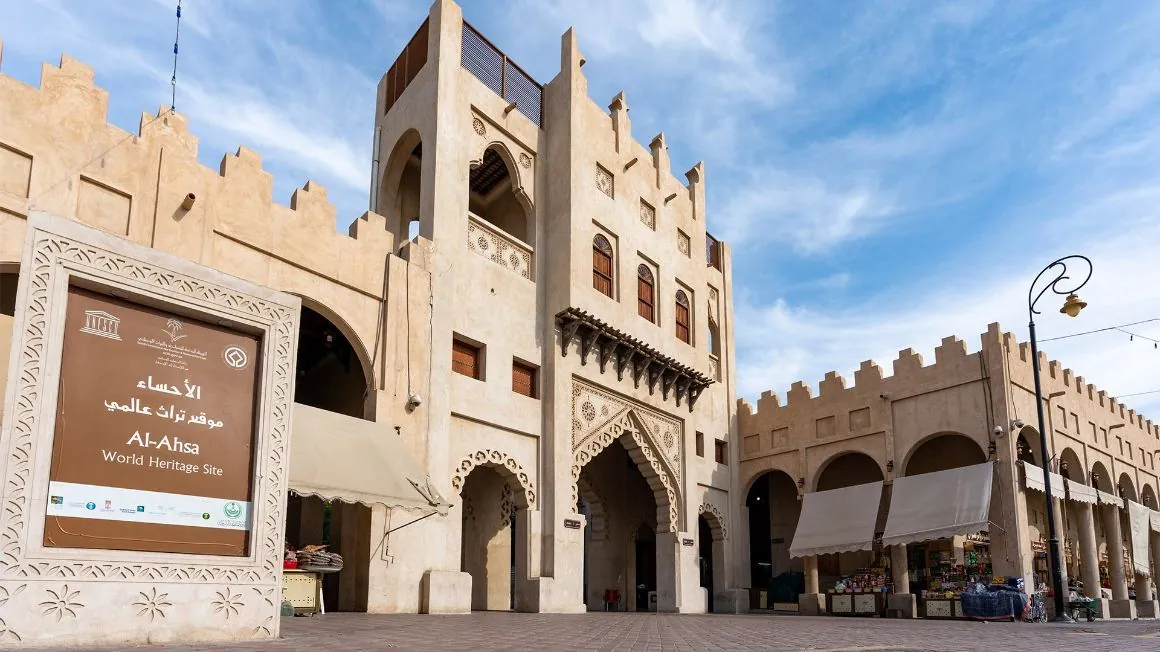
Two days are enough to feel the spirit of Al-Ahsa — the largest oasis on earth, a UNESCO World Heritage Site since 2018, where life thrives among more than 2.5 million date palms. This itinerary splits the visit the way the oasis itself is split: day one for its heritage heart in Hofuf, day two for its water, green and coast.
One note before you start: the stops here are arranged by the rhythm of the day, from morning to sunset, not by fixed hours, because opening times and fees change with the seasons. You will find the verified details on each landmark’s page on this site; confirm through official channels before you visit.
Day One: Hofuf’s Heritage Heart
Morning: Qasr Ibrahim
Begin at Qasr Ibrahim in central Hofuf — the fortress of mud walls and palm-trunk roofs, gathering mosque, barracks and towers beneath one wall. Daytime is the best time to take in the architecture and the inner courtyard.
Mid-morning: Al-Koot District and the City’s Memory
Close to the palace lies the historic Al-Koot district, home to Bayt Al-Bay’ah — the Al-Mulla family house built by Al-Ahsa’s judge, Sheikh Abdulrahman bin Omar Al-Mulla, in 1203 AH / 1788 CE, where the people of Al-Ahsa pledged allegiance to King Abdulaziz in 1913 and joined the Saudi state; today it is a museum. Then continue east to the Amiriah School, Al-Ahsa’s first formal government school (1937), whose historic building now serves as a house of culture.
Evening: Qaisariyah Souq
Close your first day at Qaisariyah Souq — a heritage market over two centuries old, its passages fragrant with perfume and gleaming with copper, its cloaks embroidered by local hands. Its best hours are the morning or the evening, as the shops close at midday; on Fridays it opens in the evening only. For dinner, browse the city’s options in the Restaurants & Cafés guide.
Day Two: Water, Green and the Coast
Morning: Jabal Al-Qarah and Dougha Al-Gharash
Head east of Hofuf to Jabal Al-Qarah — the geological wonder whose caves, carved by time at the heart of the oasis, stay cool in summer and warm in winter. At the mountain’s foot in Al-Qarah village, stop by Dougha Al-Gharash — the heritage pottery house handed down through the Al-Gharash family, one of Saudi Arabia’s best-known homes of the craft.
Mid-morning: Jawatha Mosque
Northeast of Hofuf, in the village of Al-Kilabiyah, stands Jawatha Mosque — one of the oldest mosques in Islam, and the first place a Friday prayer was held after Medina. Its mud walls carry one of the oldest stories in Islam. The mosque is open to visitors, with modest dress and respect for the sanctity of the place.
Late Afternoon: The Green of the Farms
If your visit falls in the Hasawi lime season, in summer from mid-June to the end of August, give the late afternoon, when the heat eases, to the Hasawi Lime Farm, where visitors pick the famous Hasawi lime (lomi) in season. Outside the season, browse the Souqs, Parks & Farms page and pick a park or farm close to your route.
Sunset: Al-Uqair
End your trip on the Arabian Gulf coast of eastern Al-Ahsa at Al-Uqair — Saudi Arabia’s first seaport on its eastern coast, where desert sands meet the blue of the sea. Just before sunset the white sands glow against the water — a fitting close to two days in the oasis.
Practical Tips
- Arrange your route before you set out: add stops to My saved places from each landmark’s page and get a ready-made route that opens in Google Maps.
- Use the map: the attractions map shows every stop in its place and helps you judge the order of your day.
- First time in Al-Ahsa? The Plan your trip page gathers the essentials of getting there and getting around.
